Dock Access Lighting
Waterfront edges and gangway hinge points represent the highest injury risk zones in any harbor facility. We implement low-glare, high-contrast access lighting solutions engineered for shifting tidal ramps and wet deck walking surfaces.
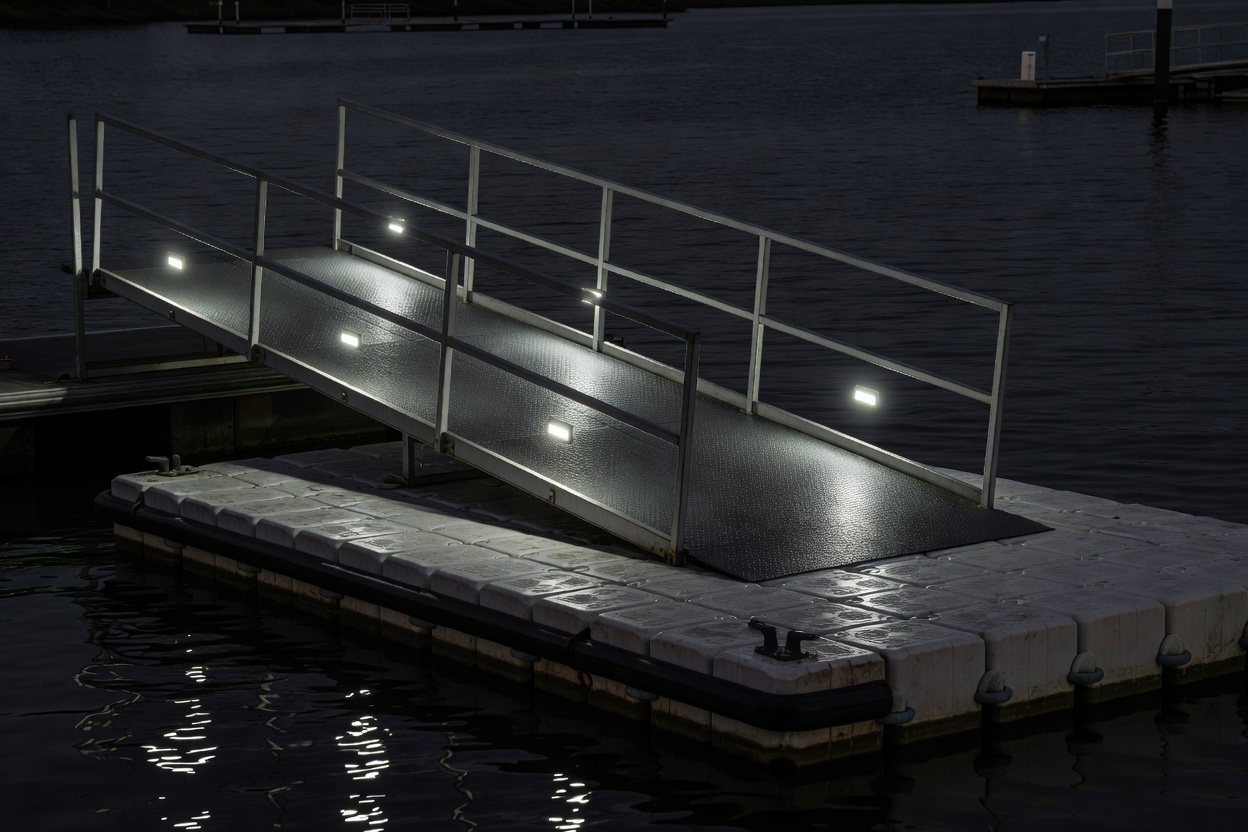
Edge Visibility Without Night Blindness
Harbor access illumination requires a critical balance: steps, ropes, cleat bollards, and open water edges must be clearly visible, but lighting fixtures must never emit upward stray glare that disrupts night-adjusted human vision.
When crew members step from a brightly lit gangway into shadow, their pupils require several seconds to adjust. During that interval, slip-and-fall incidents or missteps into the water occur.
Gangways and Articulated Ramp Transitions
Tidal ramps constantly change angle, from steep positive inclinations at low water to nearly flat or negative slopes at peak high tide. Fixtures mounted along handrails must illuminate treads uniformly across all ramp angles.
We integrate low-profile linear LED channels beneath handrail extrusions, shielded by impact-resistant polycarbonate diffusers. This protects the light source from direct impact by luggage, marine gear, or passing trolleys while providing continuous surface grazing across every step rung.
Quayside Bull-Rails and Mooring Cleat Markers
The concrete coping beam or timber bull-rail at the water's edge is an extreme hazard area during linesman mooring operations. Mooring ropes can whip under tension, and open water lies inches away.
We deploy recessed, flush-mount marine LED marker modules directly into the face of the coping beam. These fixtures illuminate the ground immediately adjacent to the edge, defining the boundary line between solid quay and open water without creating a trip obstacle for shore personnel.
Disembarkation Gate and Security Turnstile Integration
Passenger ferries and crew transfer vessels require localized illumination boosts at boarding gates to allow safe embarkation, crew ticketing, and security verification.
We design dual-level lighting systems that operate at a low-level resting state to conserve power and reduce environmental impact, automatically increasing to high-contrast task illumination when boarding gates open or automated presence sensors detect vessel docking.
Power Redundancy and Battery Backup Integration
A total power loss at a harbor terminal during an ongoing night evacuation presents severe safety risks. Access walkways and gangway routes require emergency illumination redundancy.
Our layouts incorporate dedicated central battery systems or decentralized marine-grade inverter packs providing certified illumination along escape paths and lifebuoy stations during main board electrical disconnects.
Dock Access Lighting Design Criteria
- Verify IK10 mechanical impact rating for all step and bollard luminaires.
- Ensure downward optical cutoff avoids blinding vessel captains maneuvering near docks.
- Provide marine-grade emergency battery backup to gangway transition points.
- Specify 3000K–4000K color temperatures for clear depth perception on wet concrete.
- Isolate power feeds with waterproof quick-disconnect plugs at movable ramp hinges.
Upgrade Waterfront Access Lighting
Eliminate gangway shadow hazards, glare zones, and water-edge trip risks with engineered marine access luminaires.