Harbor Lighting Installation
Waterfront lighting installation demands rigorous defense against saline moisture, wave shock, and galvanic reactions. We plan and coordinate fixture deployment across commercial wharves, cargo terminals, and perimeter breakwaters.
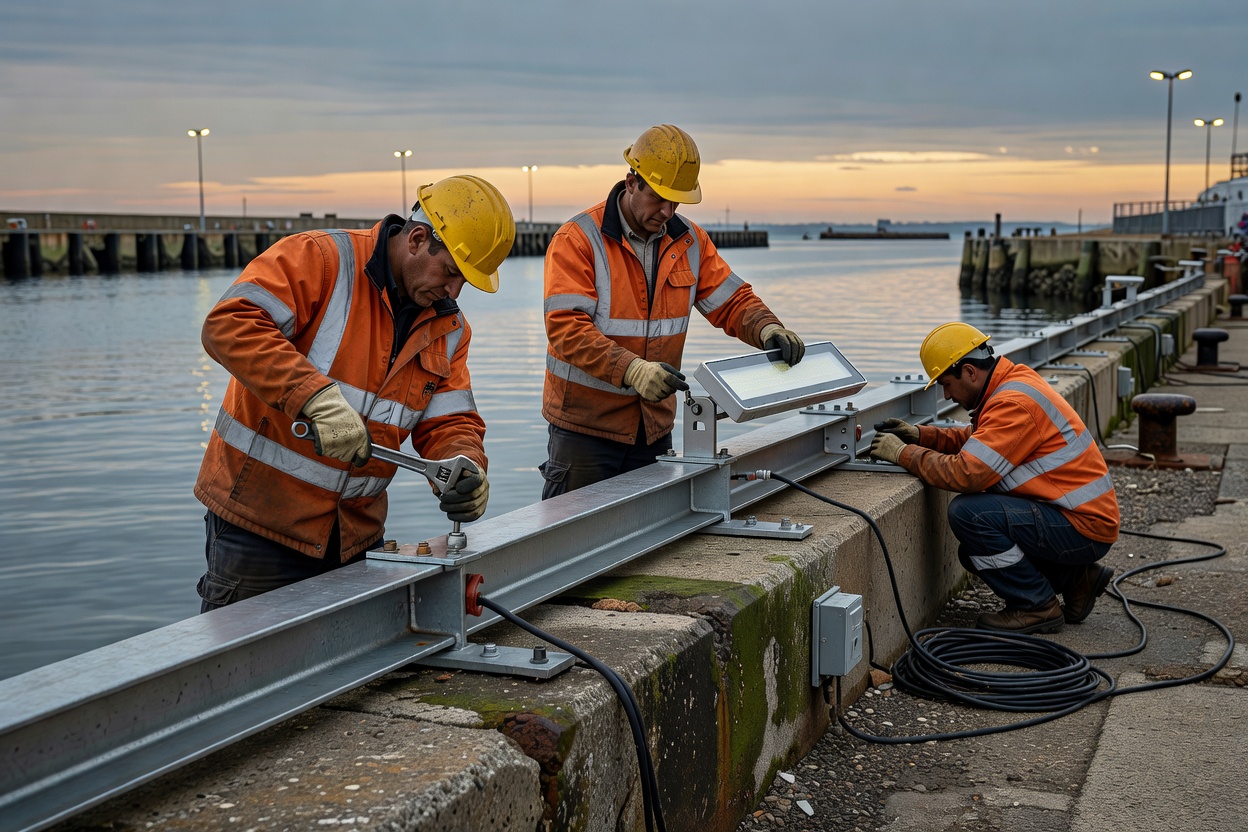
Heavy Marine Deployment Overview
Harbor installations differ fundamentally from inland industrial electrical work. Ambient humidity regularly reaches 95% with continuous airborne salt deposits. Luminaire enclosures require minimum IP66 protection, with IP67 or IP68 specified below high-water splash levels.
Fixture positions must satisfy crane clearance envelopes, ship mooring line paths, and vehicle turning radiuses. Mounting brackets must isolate aluminum light housings from steel quay columns to prevent rapid galvanic decay.
Cable Routing and Sub-Surface Conduit Strategies
Harbor quays experience settlement, tidal thermal movement, and extreme surface loads from container reach-stackers. Direct burial of electrical conduit in unreinforced asphalt leads to crushed runs within months.
We design heavy-gauge hot-dip galvanized cable trays beneath bullhead copings or specify cast-in concrete chase channels. Transition points where conduits cross from stationary quay decks to floating pontoons demand articulated stainless flexible loops with oil- and salt-resistant EPR (ethylene propylene rubber) insulated cables.
Mounting Environments and Structural Fastening
Vibration from vessel engines, bow thrusters, and cargo handling transfers directly into quay pylons. Standard friction clips loosen rapidly under this cyclic resonance.
All installation assemblies require structural A4-316 stainless steel through-bolts with nylon-insert locknuts and neoprene isolation washers. Chemical anchor studs set into marine concrete require high-bond vinyl ester resins rated for saturated, chloride-rich substrates.
Electrical Protection and Marine Surge Suppression
Coastal crane terminals frequently experience severe switching transients, crane regeneration spikes, and direct lightning exposure along tall pylons. Harbor lighting circuits require multi-stage surge protection devices (SPDs) installed both at the quay distribution board and inside the luminaire base compartment.
Residual current devices (RCDs) must be tuned to prevent nuisance tripping caused by capacitive leakage in lengthy marine feeder cables while maintaining immediate disconnection upon saltwater ingress.
Commissioning and Lux Uniformity Verification
Once mechanical fastening and terminations are complete, commissioning teams verify actual foot-candle and lux levels across the berth apron. Illumination must achieve required minimums for stevedore safe footing without creating vertical glare corridors that blind tugboat skippers and vessel watch officers during night docking.
Commissioning records capture baseline supply voltage, load amperage per phase, and thermal signatures of cable terminations under full thermal equilibrium.
Installation Engineering Checklist
- Verify structural wind loading and pylon moment ratings for luminaire surface area.
- Ensure galvanic barrier pads separate dissimilar metals (aluminum, stainless, mild steel).
- Check potted marine junction boxes for void-free silicone resin fill.
- Verify downward beam cutoff angle conforms to harbor fairway navigation constraints.
- Inspect secondary safety wire retention slings on all elevated overhead fixtures.
Review Harbor Lighting Plans
Submit your quay schematics, pylon heights, and marine environment parameters for technical coordination.